Postagens

Prevent Tragedies - Lessons learned from Texas City Refinery Explosion 2005 and RISK MANAGEMENT modules, AND THE PROACTIVE SAFETY METHOD, RISKS AND EMERGENCIES
Imagem
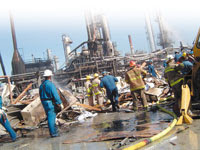
  Figure 1 - Texas City Refinery Explosion 2005 Lessons learned from Texas City Refinery Explosion 2005 and ProSREM Reference: Organizational Accidents Revisited - James Reason Background In March 2005, a hydrocarbon vapor cloud exploded at BP’s Texas City refinery, killing 15 workers and injuring over 170 others. The site was designed to convert low octane hydrocarbons, through various processes, into higher octane hydrocarbons that could be blended into unleaded petrol. This was the second-largest oil refinery in Texas and the third-largest in the US. BP acquired the Texas City refinery as part of its merger with Amoco in 1999. The refinery was built in 1934 but had been badly maintained for several years. A consulting firm had examined conditions at the plant. It released its report in January 2005, which found many safety issues that included ‘broken alarms, thinned pipe, chunks of falling concrete, bolts falling 60ft and staff being overcome with fumes’. The refinery...

Prevent Tragedies - Lessons learned from the Fukushima accident and RISK MANAGEMENT modules, AND THE PROACTIVE SAFETY METHOD, RISKS AND EMERGENCIES

Imagem
  Figure 1 - Fukushima accident Lessons learned from the Fukushima accident and ProSREM The Fukushima disaster on 11 March 2011 was caused by an external event: an exceptionally large earthquake and a subsequent tsunami. The height of the tsunami, more than 11 m, was a beyond-design basis accident (DBA). This means that although the design of the Fukushima  Daiichi plant had considered possible accident scenarios, which involved earthquakes and tsunamis, the safety precautions installed were only designed for a tsunami about half the height of what struck the plant (i.e., the design base was 5.7 m). Because the event was beyond DBA it is easy to understand that the consequences were far more severe than what had been prepared for. All critical buildings that were inundated by water lost their electric power, as did the buildings housing the emergency diesel that was assumed to power cooling pumps in the event of an accident. The plants were all shut down properly at the e...

Prevent Tragedies - Lessons learned from the Chernobyl accident and RISK MANAGEMENT modules, AND THE PROACTIVE SAFETY METHOD, RISKS AND EMERGENCIES

Imagem
  Figure 1 - Chernobyl accident Lessons learned from the Chernobyl accident and ProSREM Reference: Human and organizational factors in European nuclear safety: A fifty-year perspective on insights, implementations, and ways forward On 26 April 1986, the Chernobyl accident occurred near the city of Pripyat in Ukraine. The first information in the West was received at the Forsmark NPP in Sweden, where radiation scanners reacted on people going home after work. That caused some initial confusion, but investigations showed that the contamination was coming from outside. Assessing the fallout, it rapidly became clear that the likely origin was a nuclear accident abroad. The Soviet authorities tried to cover up the accident to their own citizens for about 36 h and, also, in their responses to the West. When a satellite picture taken on 29 April showed the burning reactor, they yielded and admitted that an accident had taken place. The sequence of events started with the preparation ...

Teoria da Propensão Individual para os Acidentes, Reason, Amalberti - Centro de Estudos Prevenir Tragédias através da Segurança Proativa e Gestão de Riscos

Imagem
TEORIA DE PREVENIR TRAGÉDIAS : Adaptado por Washington Barbosa - Referência: João Areosa A primeira grande teoria científica sobre os acidentes em contexto organizacional talvez tenha sido aquela que foi apresentada por Greenwood e Woods, onde era referido que existiria uma certa propensão individual para os acidentes. Foi a partir daqui que as causas dos acidentes começaram a estar mais centradas no indivíduo. Neste período, os acidentes eram vistos como resultado de uma única causa (ou falha técnica, ou falha humana). A teoria da propensão individual para os acidentes,  amplamente debatida na área da psicologia, incidia sobre a identificação de determinadas características individuais do sujeito sinistrado, ou seja, tentavam aferir a existência de propensões pessoais para o acidente. Numa primeira fase se desenvolveu pesquisas estatísticas onde se pretendia validar se determinados indivíduos teriam repetidamente mais acidentes, por comparação como outros indivíduos. De fato...

Prevenir Tragédias- Acidente Aéreo do time da Chapecoense e Teoria - Publicação de 18/08/2022, da coluna semanal Prevenir Tragédias da Revista Digital Norminha, de Segurança do Trabalho, de periodicidade semanal e MeSPRE

Imagem
Publicação de 18/08/2022, da coluna semanal Prevenir Tragédias da Revista Digital Norminha, de Segurança do Trabalho, de periodicidade semanal. Estou publicando semanalmente nesta revista, parte dos cases de tragédias e proposta de prevenção, que já divulgo aqui no Linkedin. Os cases estão hospedados no meu Blog da Segurança Proativa, e estão disponíveis para consulta on-line de forma gratuita. Minha contribuição para aprimorar a segurança das organizações. Mais informações, vídeos, materiais complementares, e outros artigos de acidentes e incidentes, acessar o link no final desta postagem. Será que estamos dando a atenção, as questões essenciais para a Segurança das Organizações? Quantas vidas, qual impacto social, ambiental, patrimonial, à imagem da organização e outros, seriam poupados? Importante se debruçar sobre estas questões, e aprofundar os estudos acadêmicos, com aplicação nas empresas, para desenvolver propostas para evitar estas tragédias. A seguir a proposta de prevenção e...

Preventing Tragedies - Dynamic Model of Proactive Security Management and RISK MANAGEMENT modules, AND THE PROACTIVE SAFETY METHOD, RISKS AND EMERGENCIES

Imagem
  To present a dynamic model for Safety Management, the following model is proposed, shown in Figure 1, as an adaptation of the boundaries defined by Rasmussen (1997), separating the activity to be analyzed into three areas: - Area of ​​Normality – place where the organization must be positioned; occurrence of non-conformities without criticality for a major or fatal negative event; - Danger Area - occurrence of non-conformities that are critical for a major or fatal negative event, but which have not yet led to the accident. Area of ​​action of the company's management systems, normality must be sought, diagnoses must be developed to seek endogenous and exogenous variables, which may have led to this dangerous area, and through planning, minimize the possibility of recurrence of these issues: - Accident Area - apply the emergency and mitigation plans, to seek a return to the area of ​​normality, as in the diagnosis of incidents in accidents, the endogenous and exogenous vari...